Current Space Weather

Kp Index
1.7
Quiet
Solar Flare
B-Class
Flux 6.62e-7
Solar Wind
373
km/s from NOAA plasma feed
Last Refresh
5:15 AM
May 13, 2026

Geomagnetic Activity

Quiet
Recent Kp readings from NOAA SWPC. Values of 5 or higher indicate geomagnetic storm conditions.

Aurora Outlook for Missouri

Quiet to mildly unsettled geomagnetic conditions. Aurora is not likely this far south right now.

Quick Read
Low Missouri potential right now
Storm Threshold
Kp 5+
Best Setup
Dark sky + clear weather

Aurora Viewline Tonight & Tomorrow Night

NOAA Experimental Forecast

These NOAA SWPC viewline graphics show the southern line where the aurora may be visible on the northern horizon for tonight and tomorrow night across North America.

NOAA Tonight's Aurora Viewline Forecast
Tonight's Aurora Viewline
Forecast southern extent for where aurora might be seen on the northern horizon tonight, based on NOAA's forecast Kp window.
NOAA Tomorrow Night's Aurora Viewline Forecast
Tomorrow Night's Aurora Viewline
Next-night forecast viewline from the same NOAA product, useful for seeing whether the southern visibility edge shifts north or south.

How to Read It

Red Line
Southern viewing edge
Green to Red Oval
Brighter aurora zone
Missouri Right Now
Unlikely

If Missouri is north of or close to the red viewline, there is at least a chance of seeing aurora low on the northern horizon. If the line stays well north of Missouri, viewing here is much less likely.

Actual visibility still depends on darkness, cloud cover, and local light pollution.

GOES X-ray Flux

B-Class
The long-wave GOES X-ray channel is what drives the common A/B/C/M/X flare classes.
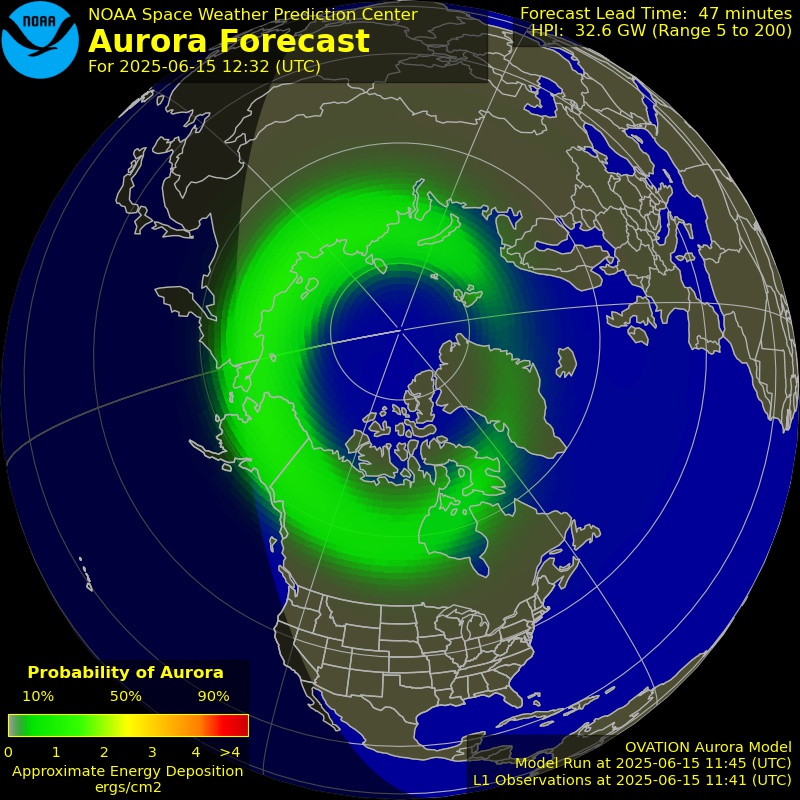
Latest NOAA aurora ovation map

Aurora Oval

Latest NOAA ovation imagery. Even when the oval expands, local cloud cover still matters for Missouri viewing.

Solar Wind Speed

373 km/s
Faster solar wind can help drive stronger geomagnetic activity when other conditions line up.

About This Page

This page uses NOAA SWPC data feeds for K-index, GOES X-ray flux, solar wind plasma, and space weather alerts. Cache refresh runs every 10 minutes when the page is visited.

Last cached update: May 13, 2026 5:15 AM

Latest NOAA Space Weather Alerts

A30F
2026-05-13 09:07:51.300
WATCH: Geomagnetic Storm Category G2 Predicted
Aurora may be seen as low as New York to Wisconsin to Washington state.
A20F
2026-05-12 13:26:26.800
WATCH: Geomagnetic Storm Category G1 Predicted
Aurora may be visible at high latitudes, i.e., northern tier of the U.S. such as northern Michigan and Maine.
XM5S
2026-05-10 14:14:33.073
R2 - Moderate
NOAA Space Weather Message
Area of impact centered primarily on sub-solar point on the sunlit side of Earth.
BHIS
2026-05-10 13:55:57.383
NOAA Space Weather Message
Space Weather Message Code: SUM10R Serial Number: 911 Issue Time: 2026 May 10 1355 UTC SUMMARY: 10cm Radio Burst Begin Time: 2026 May 10 1328 UTC Maximum Time: 2026 May 10 1334 UTC End Time: 2026 May 10 1343 UTC Peak Flux: 550 sfu Dur
TIIA
2026-05-10 13:47:47.057
ALERT: Type II Radio Emission
Space Weather Message Code: ALTTP2 Serial Number: 1484 Issue Time: 2026 May 10 1347 UTC ALERT: Type II Radio Emission Begin Time: 2026 May 10 1329 UTC Estimate Velocity: 650 km/s Comment:
XM5A
2026-05-10 13:38:09.200
R2 - Moderate
ALERT: X-Ray Flux exceeded M5
Area of impact centered on sub-solar point on the sunlit side of Earth. Extent of blackout of HF (high frequency) radio communication dependent upon current X-ray Flux intensity. For real-time information on affected area and expected duration please see http://www.swpc.noaa.gov/products/d-region-absorption-predictions-d-rap.